
Assam Polls: BJP Headed for Hat-Trick Win!
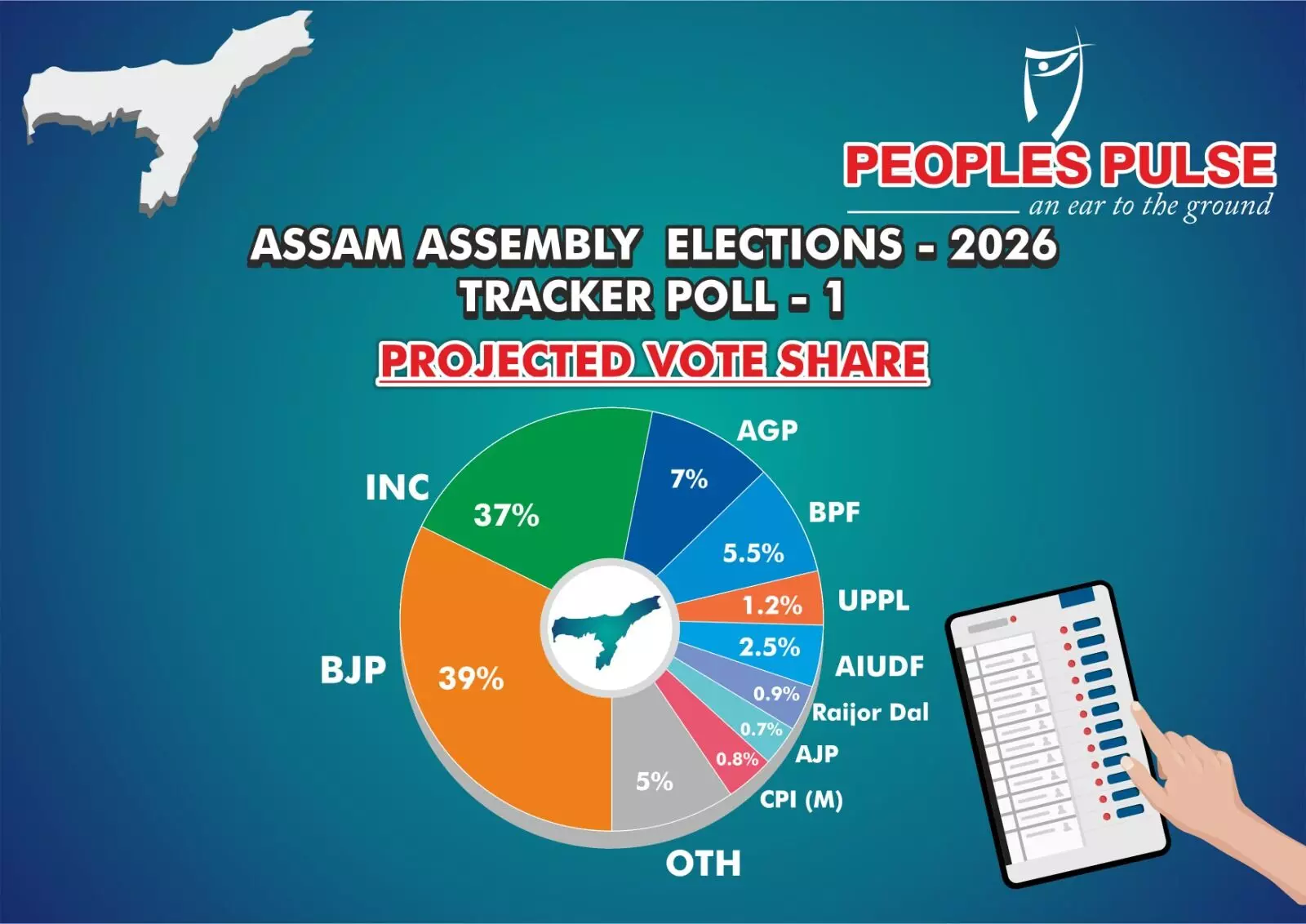


According to the latest tracker poll conducted by People’s Pulse Research, the Bharatiya Janata Party (BJP) is heading towards securing power for a third consecutive term in the Assam Legislative Assembly elections to be held this year. As per the survey conducted between November 15 and December 31, 2025, the BJP is likely to win 69–74 seats and achieve a majority in the 126-member Assembly. When combined with NDA allies, the total seat tally could touch the 90 mark. The survey revealed that the lack of unity in the opposition is working in the BJP’s favor. With strategic alliances, welfare schemes, and support from various sections, the BJP continues to maintain a strong grip in Assam. The survey was conducted under the leadership of People’s Pulse Research Director and political analyst Dr. Rajan Pandey.
“This tracker poll reflects the current mood of Assam voters. The survey clearly shows that the BJP has built strong connections with diverse sections beyond just the advantages of incumbency. Especially at a time when parties like AIUDF and UPPL are struggling for survival, the NDA’s victory appears to be a cakewalk,” he said.
Clear Edge for the BJP
According to the People’s Pulse tracker poll estimate, the BJP is set to emerge on top with 69–74 seats. The Congress is expected to win only 25–29 seats. NDA allies Asom Gana Parishad (AGP) may secure 8–11 seats, while the Bodoland People’s Front (BPF) could get 8–10 seats. Smaller parties are far behind. AIUDF is likely to win 0–2 seats, UPPL 0–2, Raijor Dal 1–2, Assam Jatiya Parishad (AJP) 0–1, CPI(M) 0–1, and Independents/Others 0–1 seats.
With the magic figure being 64 seats, the NDA stands far ahead. The BJP has a strong chance of forming the government single-handedly for the third time. This would place it alongside the Congress, which earlier achieved three consecutive victories in the state. The tracker poll survey found that the BJP’s ability to retain its core vote bank while expanding into new sections is the key reason for this performance.
In terms of vote share, the BJP is projected to receive 39%, while the Congress may get 37%. Although the difference in vote share is small, in Assam’s tightly contested electoral environment, this could result in a significant difference in seat count. Other parties’ projected vote shares are: AGP 7%, BPF 5.5%, UPPL 1.2%, AIUDF 2.5%, Raijor Dal 0.9%, AJP 0.7%, CPI(M) 0.8%, and Others 5%. The survey revealed that the Congress vote share has increased due to Muslim voters shifting from AIUDF towards the Congress, but due to delimitation, NDA social coalitions, and weak opposition partners, the Congress is lagging in converting votes into seats.
Who Will Be the Next Chief Minister?
When asked who would be the best choice for the next Chief Minister, incumbent Chief Minister Himanta Biswa Sarma led with 30% support. Former Chief Minister Sarbananda Sonowal received 28% support, while Congress MP and state president Gaurav Gogoi was backed by 27% of voters. Debabrata Saikia received 3%, while Hagrama Mohilary, Atul Bora, Dilip Saikia, Badruddin Ajmal, and Akhil Gogoi each received 1%. Seven percent of voters said they were undecided. Despite Gaurav Gogoi’s personal popularity and position in the CM race, it did not translate into support for the Congress party. Himanta Biswa Sarma’s slight edge was backed by strong support from women voters, while tribals and men largely leaned towards Sonowal.
Support Favors the BJP
When asked which party is better for Assam’s development, 48% supported the BJP, while 38% favored the Congress. On the question of who would form the next government, 55% believed the BJP would win, while 40% supported the Congress. When asked whether the BJP should be given another chance, 55% responded positively and 45% negatively. The BJP showed an overall advantage in areas such as development, welfare, support from various sections, CM choice, party performance, age, and gender factors. The BJP’s consistent lead in mandal, panchayat, municipality, various by-elections since 2021, and the 2024 Lok Sabha elections has further strengthened the party. By gaining support among tribals and OBCs, the NDA has expanded its reach further. The survey found that the limited support received by the Congress is mainly due to Muslim voters shifting from AIUDF in the Barak Valley and Lower Assam regions. Due to views on business interests and controversial alliances, AIUDF has become politically isolated. AGP is dependent on the BJP, and without an alliance, its base is weakening. UPPL is facing a survival crisis after a weak performance in the recent BTAD elections. Bodo voters have shifted back towards the BPF. The BJP–BPF reunion is paving the way for a clean sweep in the BTAD regions. Smaller parties like Raijor Dal and AJP continue to have limited impact.
Which Caste Supports Whom?
In terms of caste dynamics, Assamese voters largely support the BJP, though some back the Congress and regional parties. Except for a few areas like Sivasagar and Jorhat among the Ahoms, the BJP shows dominance across regions. Other OBCs are also inclined towards the BJP. Post-CAA, Hindu Bengalis are supporting the BJP. Muslims are largely backing the Congress and rejecting AIUDF. Support for the NDA among tribals is steadily increasing, with Bodos favoring the BPF–BJP alliance, while Misings, Karbis, Dimasas, and others are also inclined towards the BJP. Due to welfare schemes, tea garden communities are largely with the BJP, though some dissatisfaction is visible among them.